





























( accidentals, vol. 02 )
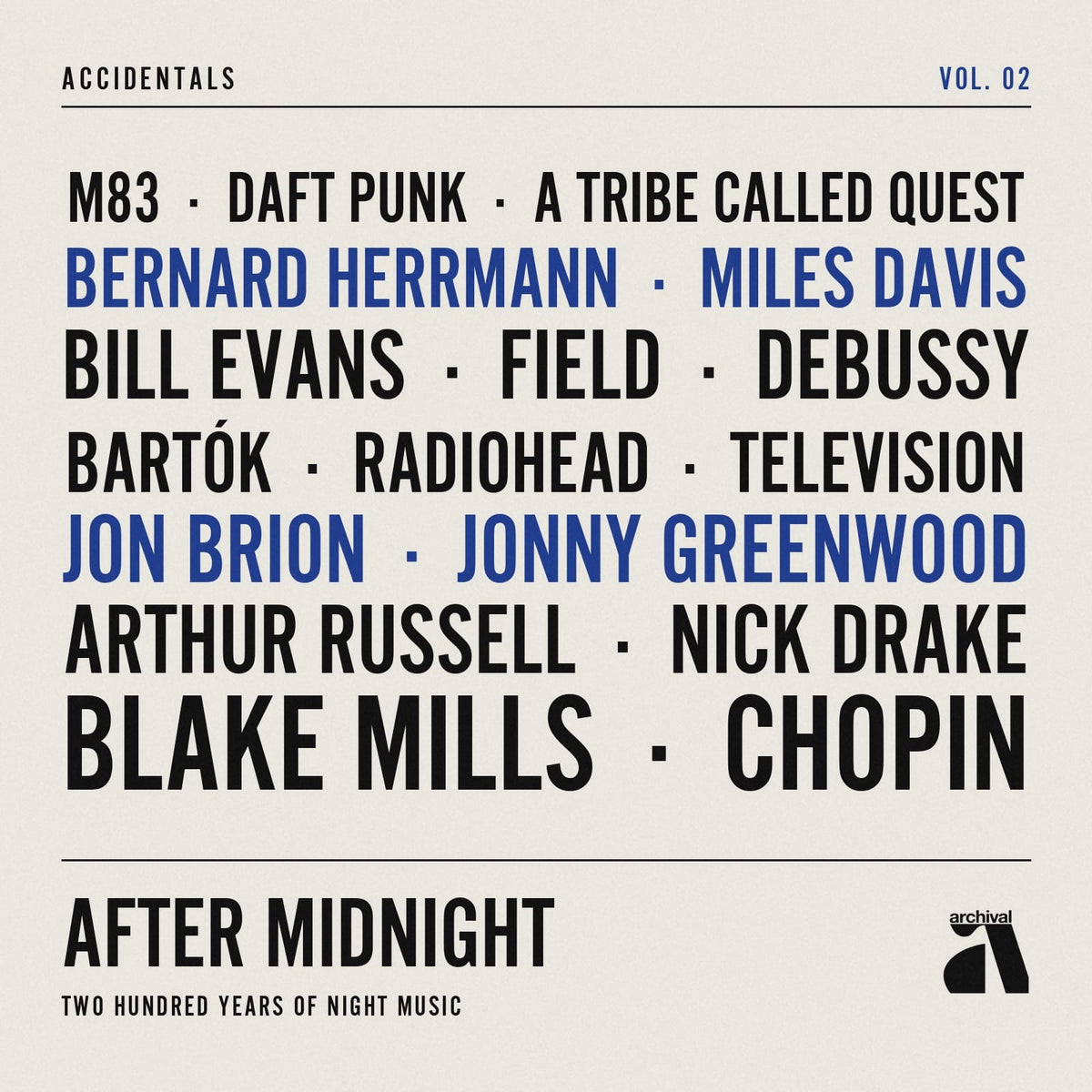
AFTER MIDNIGHT
Two hundred years of night music.
17 tracks, 81 minutes, best heard in order
John Field, a pianist from Dublin, wrote the first nocturnes. Chopin took the name and made it famous, and Debussy borrowed it again from Whistler's paintings of the Thames at night. This volume follows a night the way nights go. It starts loud and bright with M83's "Midnight City", rides through Daft Punk and A Tribe Called Quest, and catches a cab with Bernard Herrmann's last score. Then the club: Miles Davis's "Blue in Green", and Bill Evans alone at the piano for "Peace Piece". After that the night gets stranger, with Debussy's clouds, Bartók's insects and toads, and "Pyramid Song", until Television's "Marquee Moon" brings the peak, all ten and a half minutes of it. The small hours belong to film scores, Arthur Russell, Nick Drake and Blake Mills, and a Chopin nocturne published after his death closes it. Listen for the two chords Evans rocks between, and for the cor anglais in "Nuages".
Listen for
- 05 → 06Miles, then Bill EvansEvans is the pianist on “Blue in Green”. “Peace Piece” is him alone, recorded months before Kind of Blue.
- 07John FieldAn Irish pianist invented the nocturne. Chopin borrowed the name and made it famous.
- 04Bernard HerrmannTaxi Driver was his last score. He died hours after finishing the recording sessions.
Side A
31:23- 01Midnight CityM834:01
Anthony Gonzalez made the squealing hook that runs through it from his own voice, heavily distorted. Stay for the ending: the saxophone solo, played by James King of Fitz and the Tantrums, is the 1980s arriving all at once.
- 02Veridis QuoDaft Punk5:45
From Daft Punk's Discovery (2001). The title is usually read as a pun on "very disco", but the track is slow, faux-baroque synthesizer music, chords unfolding at a walk. The first breath of the night.
- 03Electric RelaxationA Tribe Called Quest3:46
From Midnight Marauders (1993). The loop comes from Ronnie Foster's "Mystic Brew", with a piece of Brethren's "Outside Love", and Q-Tip and Phife Dawg trade verses over it as if there's nowhere to be until morning.
- 04Taxi Driver: Main TitleBernard Herrmann2:14
Herrmann recorded the score on 22 and 23 December 1975 and died hours after finishing, on Christmas Eve. Scorsese dedicated the film to him. Listen for the drums and brass giving way to the saxophone.
- 05Blue in GreenMiles Davis5:37
Recorded on 2 March 1959 for Kind of Blue, with Davis on muted trumpet. The tune runs in a ten-bar cycle, unusual in jazz. The record credits only Davis; Evans said in 1979, "The truth is I did."
- 06Peace PieceBill Evans6:44
Two chords, C major seventh and G with a suspended fourth, rocked back and forth in the left hand while the right hand drifts further out. Evans improvised it at the end of a December 1958 session. The same material opens "Flamenco Sketches" on Kind of Blue.
- 07Nocturne No. 5 in B-flatJohn Field3:16
Field, born in Dublin in 1782, published his first nocturnes in 1814 and died in Moscow. Chopin took the name and the shape: a singing melody in the right hand over a wide, rocking left hand. This one is short and very calm.

Carl Mayer after Anton Wachsmann, John Field, c. 1835 · Public domain, via Wikimedia Commons

Side B
49:41- 08Nocturnes: I. NuagesClaude Debussy6:21
Debussy said it shows "the slow, solemn motion of the clouds". The idea reportedly came to him crossing a Paris bridge on a stormy day, as a boat sounded its horn. Listen for the cor anglais: a short chromatic phrase that keeps coming back.

James McNeill Whistler, Nocturne in Black and Gold: The Falling Rocket, 1875 · Public domain, via Wikimedia Commons - 09Out of Doors: The Night's MusicBéla Bartók5:16
From Out of Doors (1926). Bartók wrote down the sounds of a Hungarian summer night: birds, cicadas and the call of the fire-bellied toad. A soft cluster chord ticks under it all, and at one point the pianist is asked to play a cluster with the palm of the hand.
- 10Pyramid SongRadiohead4:48
Thom Yorke wrote the lyric after seeing an exhibition of ancient Egyptian underworld art while Radiohead were recording in Copenhagen; the song also owes something to Charles Mingus's "Freedom". The piano lurches so freely that people still argue about the time signature. Jonny Greenwood told the string players to swing.
- 11Marquee MoonTelevision10:38
This is the full 10:40 take; the original LP faded out just short of ten minutes. Richard Lloyd plays the short solo after the second chorus. Tom Verlaine's solo, after the third, takes up the whole second half of the song.
- 12Phone CallJon Brion1:02
From Jon Brion's score for Eternal Sunshine of the Spotless Mind (2004), Michel Gondry's film about erasing the memory of a love affair. At about a minute it's the shortest thing here: a cue, not a song, and a breather after Television.
- 13House of WoodcockJonny Greenwood3:53
From Greenwood's score for Phantom Thread (2017). He named Glenn Gould's Bach recordings and Nelson Riddle's arrangements among his models. Katherine Tinker plays the piano, with the London Contemporary Orchestra conducted by Robert Ames. The score was nominated for an Oscar.
- 14A Little LostArthur Russell3:18
From Another Thought (1993), the first collection of Arthur Russell's music released after his death in 1992. Russell was a cellist who moved between disco, experimental composition and songs like this one, which are plain, close and a little unsteady on their feet.
- 15Northern SkyNick Drake3:43
From Bryter Layter (1971), produced by Joe Boyd. John Cale plays the piano, celeste and organ, and it's his celeste that makes the song glow. Drake sings it unhurried, as if it's already very late.
- 16Vanishing TwinBlake Mills6:16
From Mutable Set (2020), co-written by Blake Mills and Cass McCombs. It moves at walking pace for more than six minutes, which is about the right speed for the last stretch home.
- 17Nocturne in C-sharp minor, Op. posth.Frédéric Chopin4:26
Chopin wrote it in 1830 for his sister Ludwika, to practise before she tackled his Second Piano Concerto, and it quotes that concerto. It was published in 1875. In September 1939 Władysław Szpilman was playing it live on Polish Radio when the German assault on Warsaw cut the broadcast.

Louis-Auguste Bisson, Frédéric Chopin, 1849 · Public domain, via Wikimedia Commons