


















( accidentals, vol. 04 )
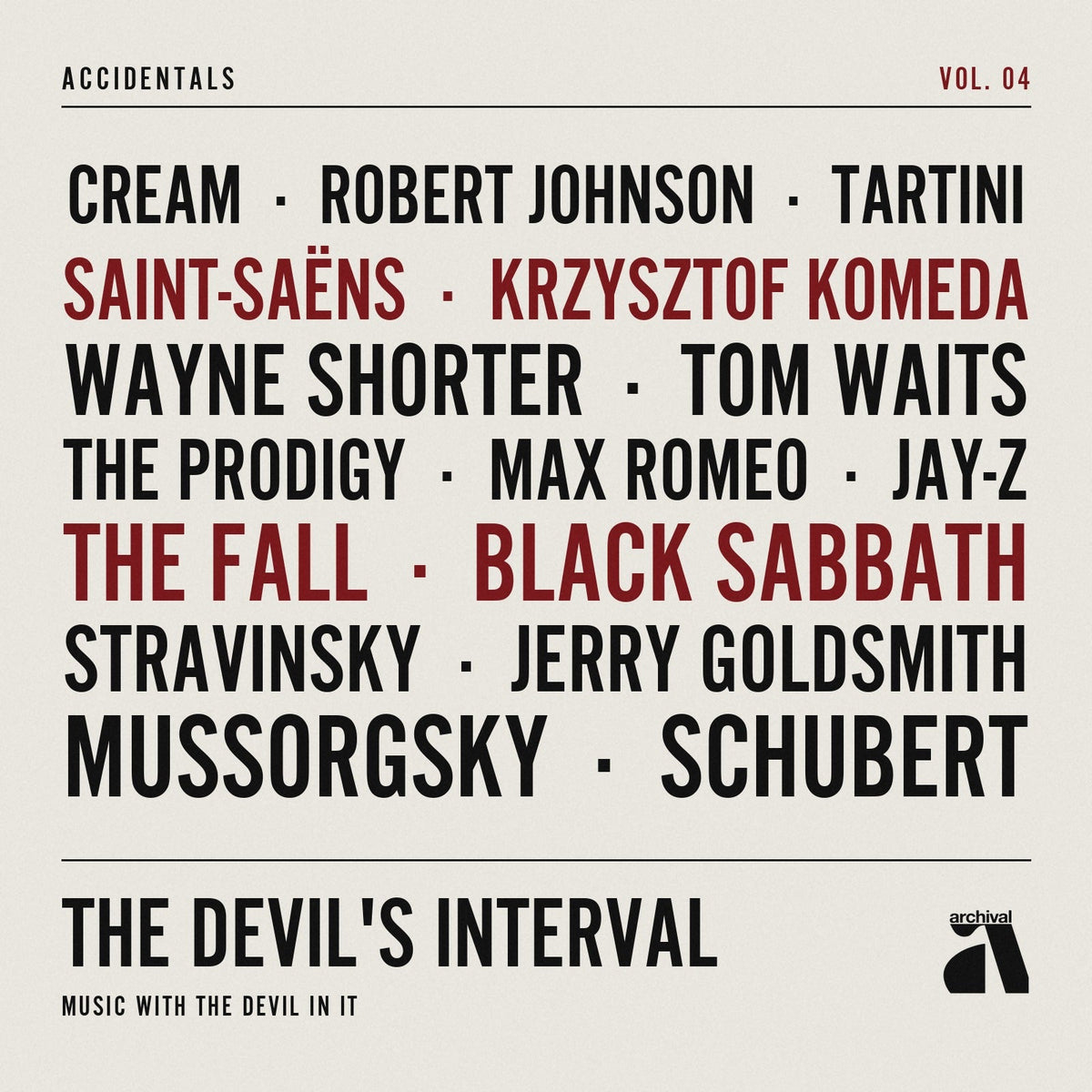
THE DEVIL'S INTERVAL
Music with the devil in it.
16 tracks, 80 minutes, best heard in order
The tritone, three whole steps wide, was nicknamed diabolus in musica long before heavy metal found it. Saint-Saëns retuned a violin string to get it; Black Sabbath built a riff on it. This volume follows the Devil through nearly three centuries of music. It opens at the crossroads, with Cream's 1968 "Crossroads" and the 1936 Robert Johnson song it came from, then Tartini's sonata, which he said the Devil played him in a dream. Side B starts with a hard cut into rave: the Prodigy, the Max Romeo record they sampled, and Jay-Z's "Lucifer", built from the same song. The peak is Black Sabbath's title track, followed by a second hard cut into Stravinsky's march for the Devil. Then the exorcism: the choir from The Omen, "Night on Bald Mountain" and Schubert's "Ave Maria", the pairing that ends Disney's Fantasia. Listen for the harp striking midnight in "Danse macabre", and for the church bell that ends the night on the mountain.
Listen for
- 01 → 02Cream, then Robert JohnsonCream's 1968 Winterland blast, then the 1936 Robert Johnson song it was built from.
- 08 → 10One devil, three recordsThe Prodigy and Jay-Z both built tracks from Max Romeo's 1976 'Chase the Devil', which sits between them.
- 15 → 16Bald Mountain, then dawnDisney's Fantasia ends exactly like this: Chernabog's night on the mountain, then church bells and Schubert's Ave Maria.
Side A
36:32- 01CrossroadsCream4:17
Recorded live at the Winterland Ballroom in San Francisco on 10 March 1968 for Wheels of Fire. Clapton kept Johnson's first and last verses, added one from Johnson's "Traveling Riverside Blues", and straightened the whole thing into a twelve-bar shuffle. Then he solos over it.
- 02Cross Road BluesRobert Johnson2:29
Recorded on 27 November 1936 in a makeshift studio in a San Antonio hotel room. The lyric never mentions the Devil; the soul-selling story was attached to Johnson later. Listen for what Cream left out: the slide, the open tuning, and verses that stretch and shrink as he likes.
- 03Violin Sonata in G minor "Devil's Trill": III. Andante – Allegro assaiGiuseppe Tartini7:34
Tartini's dream, as the astronomer Lalande reported it: the Devil took his violin and played a sonata, and what Tartini wrote down on waking was "so inferior" he'd have given up music if he could. He dated it 1713; scholars think the 1740s. The trills come in the last movement. Here Ray Chen plays it with piano.
- 04Danse macabre, Op. 40Camille Saint-Saëns6:55
Midnight on Halloween: a harp strikes twelve, Death tunes his fiddle, and the skeletons dance until the cockerel crows. The solo violin's top string is tuned down to E-flat, so its open strings sound the tritone. Listen for the xylophone rattling bones, and the Dies irae in a major key.

Atelier Nadar, Camille Saint-Saëns, between 1890 and 1910 · Public domain, via Wikimedia Commons - 05Lullaby (Rosemary's Baby)Krzysztof Komeda2:24
Polanski asked Mia Farrow to sing Komeda's lullaby herself, with no words, over the titles. Lyrics were added later the same year and it became "Sleep Safe and Warm". Without them it's sweeter, and much more unsettling.
- 06Witch HuntWayne Shorter8:10
Recorded on Christmas Eve 1964 for Speak No Evil, with Freddie Hubbard, Herbie Hancock, Ron Carter and Elvin Jones. In the original liner notes Shorter talked about misty landscapes, folklore and legends, and witch burnings. The horns state the theme together, like a summons.
- 07Way Down in the HoleTom Waits4:43
From Franks Wild Years (1987), which began as a stage show at Steppenwolf Theatre in Chicago. The Wire used a different version every season, and Waits's own opened season two. A gospel stomp about keeping the Devil down in the hole.

Side B
43:40- 08Out of SpaceThe Prodigy5:02
The Prodigy's 1992 single, from Experience: Max Romeo's voice from the next track, a line from Kool Keith of Ultramagnetic MCs, and breakbeats at rave speed. It reached No. 5 in the UK. The hard cut from Tom Waits is deliberate.
- 09Chase the DevilMax Romeo3:26
Max Romeo and the Upsetters, 1976, from War Ina Babylon, produced with Lee "Scratch" Perry. Romeo later said the Devil in the song stands for negative forces in the mind. You'll recognise the line about sending him to outer space.
- 10LuciferJAY-Z3:12
Kanye West produced it for Jay-Z's The Black Album (2003), building the beat from resung samples of "Chase the Devil". This is the clean version. Listen for Romeo's melody coming back in a different voice, twenty-seven years on.
- 11Lucifer Over LancashireThe Fall5:13
Written by Mark E. Smith and Steve Hanley and first released in 1986 as the B-side of "Mr. Pharmacist". The Devil here isn't at a crossroads. He's loose in the north of England, and Smith reports it like local news.
- 12Black SabbathBlack Sabbath6:18
Recorded on 17 November 1969 and released on the band's first album in February 1970. Geezer Butler had been playing a fragment of Holst's "Mars"; Tony Iommi came back the next day with this riff: G, its octave, then C-sharp, the tritone. Three notes, and the whole subject of this volume.

Francisco Goya, Witches' Sabbath (El aquelarre), 1797–98 · Public domain, via Wikimedia Commons - 13L'Histoire du soldat: Triumphal March of the DevilIgor Stravinsky2:02
Stravinsky's 1918 theatre piece for seven players, in which a soldier trades his violin to the Devil for a book that predicts the stock market. This is the last number, the Devil's victory march. Listen to the violin drop out and leave the percussion to finish alone.
- 14Ave SataniJerry Goldsmith2:35
Goldsmith wrote it as a Satanic answer to Gregorian chant, with Latin that turns phrases of the Mass inside out; the title means "Hail Satan". The Omen (1976) won him the Oscar for its score, and this song was nominated too.
- 15Night on Bald MountainModest Mussorgsky11:00
Mussorgsky first wrote it in 1867 as St John's Eve on Bald Mountain, and it was never performed in his lifetime. The version most people know is Rimsky-Korsakov's of 1886, played here by Leonard Bernstein and the New York Philharmonic. Near the end a church bell sounds and the spirits scatter at dawn.

Ilya Repin, Modest Mussorgsky, 1881 · Public domain, via Wikimedia Commons - 16Ave Maria, D. 839Franz Schubert4:52
Schubert's 1825 setting of a song from Walter Scott's The Lady of the Lake, sung by Marian Anderson with her long-time accompanist, Kosti Vehanen. In 1935 Toscanini told her she had a voice heard once in a hundred years. After the mountain, the dawn.